
Laravel is a PHP framework for building web applications and custom content systems. We use it when a project needs an admin panel, real business rules and hosting that works anywhere PHP does — which in the GCC often means a cPanel plan the client already pays for.
What is Laravel?
Laravel is the most widely used PHP framework, and PHP still runs a large share of the web — including most of the hosting sold in this region. That combination is the practical reason it appears on so many of our projects: it is a modern framework that deploys to infrastructure a small business already owns.
What you get out of the box is the unglamorous half of every application: authentication, database migrations, queued jobs, scheduled tasks, form validation, file storage and a templating layer. None of that is interesting to a client, and all of it is expensive to write badly. Using a framework that has solved it means the budget goes to the part of the system that is actually specific to your business.
It is also genuinely stable. Code written against Laravel five years ago still reads clearly, which matters when the person maintaining it in year three is not the person who wrote it.
When we choose Laravel
Laravel is our default when the project has an admin side. A site whose content changes weekly, a portal with accounts and permissions, anything with an approval step or an audit trail — those are Laravel projects.
It is also the right answer when hosting is constrained. A large share of GCC small and mid-market businesses are on shared cPanel plans, and Laravel deploys there with nothing more exotic than PHP and MySQL. That single fact decides the stack more often than any technical argument: a beautiful Node application the client cannot afford to host is not a solution.
Finally, we choose it when the client has an in-house PHP developer. Handing over a codebase your own team can already read is worth more than a marginally faster framework they cannot.
When we do not use Laravel
We do not use Laravel for a highly interactive interface. If the product is a live collaborative editor, a mapping tool with continuous updates, or a dashboard that streams data, a JavaScript framework doing the rendering will feel better and be less work.
We also avoid it for pure static content. A five-page brochure site does not need a database, an application server or a deployment pipeline, and putting Laravel behind it adds running cost and a patching obligation for no benefit.
And if your engineering team is a Node or .NET shop, we will build in their language rather than leaving them a PHP application they resent. The best stack for a project is frequently the one the people who inherit it already know.
What we build with Laravel
Custom content systems, not another page builder
A CMS shaped around what you actually publish: if you sell services, the editor has a service type with a timeline and a price band, not a blank page and a drag-and-drop toolbar. Editors get exactly the fields the design needs and nothing else, which is what stops a site drifting away from its own design system six months after launch.
Booking and scheduling with real availability
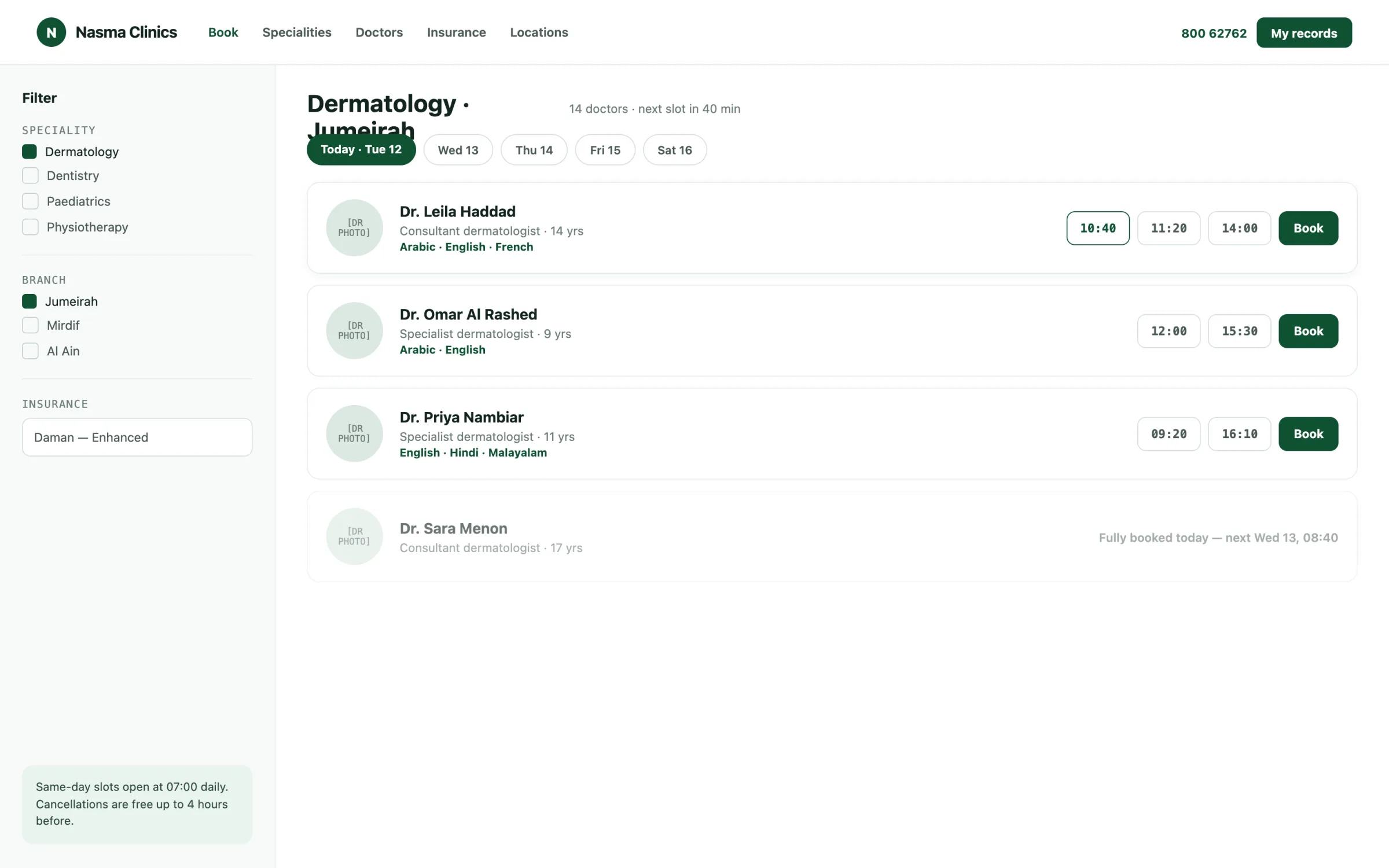
Clinic appointments, consultations, service call-outs. The hard part is never the calendar UI — it is the rules underneath: which staff can do which service, how long a slot really takes, what happens when two people book the same minute, and whether a deposit holds the slot. Laravel handles that with database transactions, so a double booking is impossible rather than unlikely.
Internal dashboards and operations portals
The system that replaces the spreadsheet the business is actually run from. Roles and permissions, an audit trail of who changed what, exports the finance team can open in Excel, and integrations with whatever already holds the data. These are the projects where the interesting work is the business rules, and Laravel keeps the plumbing out of the way.
Bilingual sites on shared hosting
English and Arabic on one Laravel install, each language on its own crawlable URL with translated slugs, full RTL layout and hreflang set up correctly. It deploys to a cPanel plan with PHP and MySQL, which for a lot of GCC businesses is the difference between shipping this quarter and waiting for infrastructure budget.
How we ship Laravel projects
Every Laravel project ships with a custom admin panel — not a generic scaffold. Your team gets the fields the site actually uses, with hints written for a marketer rather than a developer, and a bilingual tab on every content type so Arabic is entered alongside English rather than as a later project.
Deployment is to your hosting, from your repository. Migrations run on deploy, and every content model is seeded so a fresh install has real content rather than an empty database. On shared hosting we ship a guided installer so the whole setup is a database name, a user and a password.
Testing covers the business rules, not the framework: the booking conflict, the permission check, the invoice total. That is where bugs cost money.
What Laravel costs you
Laravel renders on the server, so a highly interactive screen needs JavaScript layered on top. For most business software that is fine — the interactions are forms and tables — but if your product is closer to a design tool than a database, you will end up writing that layer anyway, and starting from a JavaScript framework would have been cheaper.
PHP also carries a reputation problem that occasionally matters when raising money or hiring. It is not a technical argument — the language is fast and modern now — but if your investors or your future CTO will judge the stack, that is worth naming before we build rather than after.
And Laravel releases a major version every year. We target the current LTS and budget an upgrade window every two years, which keeps security patches applying cleanly instead of accumulating into a rewrite.
Laravel questions we get asked
Yes. Laravel runs applications with millions of records and hundreds of concurrent users routinely. The limits you hit first are almost always database design and hosting, not the framework. We size the database properly in the architecture phase, which is the week that actually determines whether the system scales.
Almost certainly. Laravel needs PHP 8.3 or newer and MySQL, both standard on current cPanel plans. We ship a guided installer that checks the requirements, takes your database details, and sets everything up — no command line and no Composer on the server.
Use WordPress when the site is content and the content is articles — it is very good at that. Choose Laravel when the site has rules: bookings that cannot collide, permissions that differ per user, calculations finance will audit. Bending WordPress into an application usually means five plugins that each update on their own schedule, and that is where the maintenance cost appears.
That is the point of the admin panel we build. Every content type your site uses gets a form with plain-language labels and hints, an English and an Arabic tab, and a media library. Handover includes a session with your team and written documentation. If you still need us for routine content changes, we built it wrong.