
Whisper is OpenAI's speech-to-text model. It handles accented English, Gulf Arabic and switching between the two mid-sentence better than most alternatives, which is what makes it usable for voice features in this region.
What is Whisper?
Whisper converts audio to text. What distinguishes it for our market is robustness: it was trained on a very large and very varied set of audio, so it copes with accents, background noise and imperfect microphones far better than earlier systems, and it detects the spoken language automatically.
The code-switching behaviour is the part that matters most here. People in the GCC routinely move between Arabic and English inside a single sentence, and a transcription system that assumes one language per recording produces nonsense on exactly the input it will receive most often.
When we choose Whisper
For voice input in a multilingual market. It is the practical default when users will speak Arabic, English or both, and no configuration decides which.
For turning call recordings and voice notes into searchable text — support calls, site reports, dictated notes.
When we do not use Whisper
For live captioning where every word must appear as it is spoken. Whisper works on complete clips rather than continuously, and a system built around streaming it is fragile — we learned that on RetailDirect and wrote it up.
And where recordings cannot leave the country. A hosted transcription API is then out, and a self-hosted model becomes the conversation.
What we build with Whisper
Voice ordering
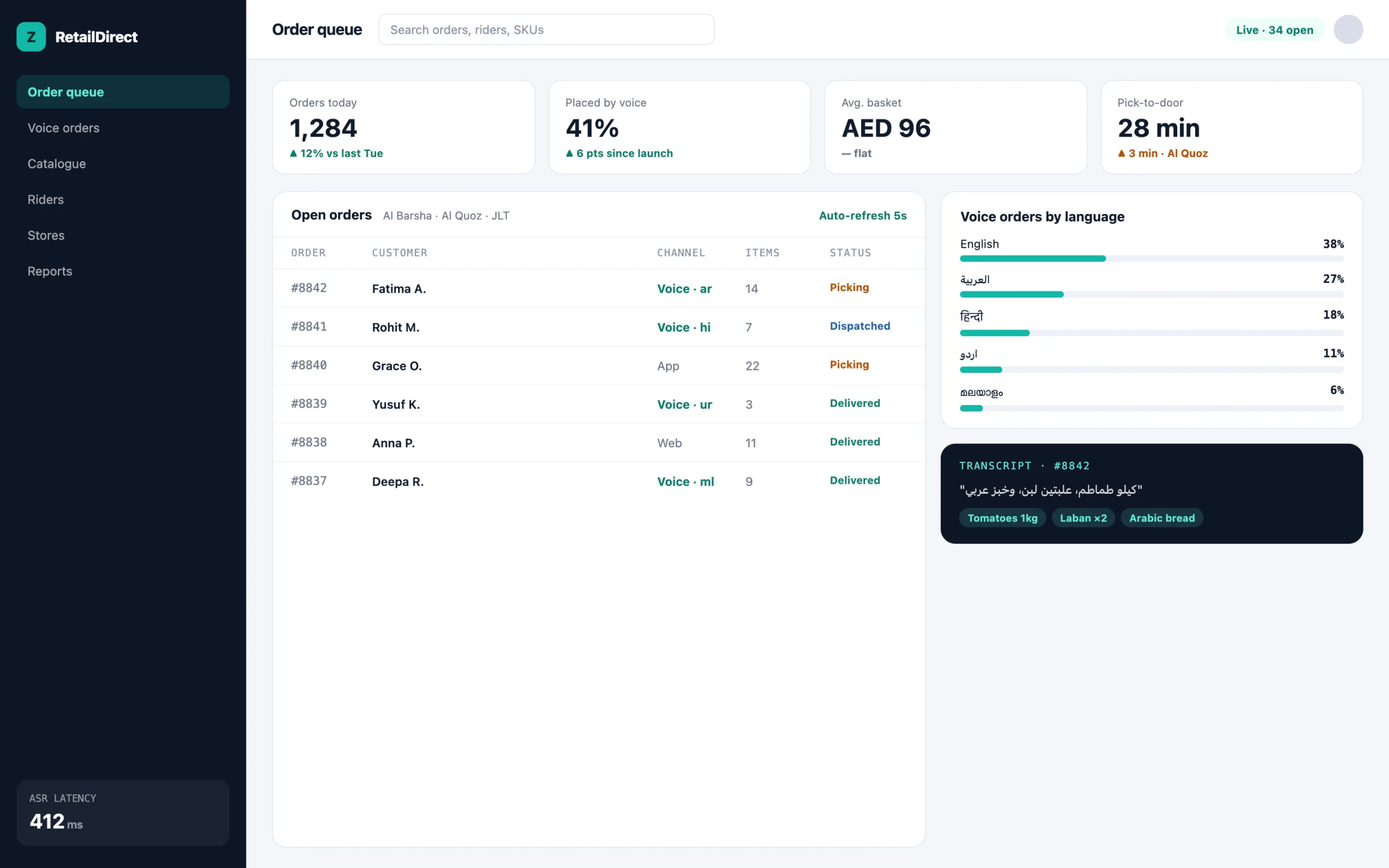
A customer speaks their order; a picker sees a clean, priced basket. RetailDirect runs this in over 100 languages, and 41% of its orders now arrive this way.
Field reports by voice
A technician records a note on site; it becomes a structured record in the system. Faster than typing on a phone with gloves on, which is the actual constraint.
Searchable call archives
Support and sales calls transcribed and indexed, so a question like "how often do customers ask about delivery times" has an answer from recordings rather than an opinion from a meeting.
Accessibility and subtitles
Captions for video content in both Arabic and English, generated automatically and corrected by an editor. Required for public sector work here and worth doing regardless.
How we ship Whisper projects
Press-and-hold rather than live streaming. Streaming demos beautifully and fails on a real network: a two-second signal drop in a lift closes the socket mid-sentence and loses the whole order. A held clip uploads as one retryable request, and it gives the user a natural moment to check the transcript before it becomes an order.
Always with the transcript shown for correction. That single change cut wrong-item support tickets on RetailDirect by roughly two thirds, and none of it was the model getting better.
With the transcript always visible and editable before it becomes an action. On RetailDirect that single interface decision cut wrong-item support tickets by roughly two thirds, and none of it came from the model improving.
What Whisper costs you
It is not instant — a clip takes a moment to process, which is why the interface has to acknowledge the recording immediately rather than waiting for the text.
Accuracy drops with heavy background noise and very short utterances, so single-word commands are a poor fit. And specialist vocabulary — product codes, local place names — needs correction rules on top, which we build from the client's own catalogue.
Cost is per minute of audio, so a call-recording archive is a different budget from a voice-ordering feature. We estimate it against your real volume during discovery instead of quoting a per-request figure that means nothing.
Punctuation and speaker separation are also weaker than the transcription itself. For a searchable archive that is fine; for a published transcript it needs a human pass, and we say which one you are getting.
Whisper questions we get asked
Better than most, and not perfectly. Modern Standard Arabic is strong; dialect accuracy varies and improves considerably when you add correction rules for your own product names and terms. We test against your real recordings during discovery rather than promising a number.
Because it fails on real networks. A two-second signal drop closes the connection mid-sentence and the whole utterance is lost. A press-and-hold clip uploads as one retryable request and gives the user a moment to check the transcript before it becomes an order.
Poor out of the box and good with correction rules built from your own catalogue. Specialist vocabulary is the one place every transcription system needs help, and it is a day of work rather than a research problem.
Yes — Whisper can be self-hosted, which is the answer when recordings cannot leave your infrastructure. It needs a GPU to be fast, so the cost moves from per-minute API charges to a monthly server bill. We model both before recommending either.
Better than older systems and not perfectly. Background noise and very short utterances are where accuracy drops. Showing the transcript for confirmation covers the gap — the user corrects the one word that came out wrong rather than the order being wrong all the way to dispatch.
A few seconds for a short clip, which is fast enough for press-and-hold input and too slow to feel instant. The interface has to acknowledge the recording immediately and show the transcript when it arrives, rather than leaving the user looking at a frozen screen wondering whether it heard them.
Over a hundred, with automatic detection rather than the user choosing. That matters in a market where a delivery driver might speak Urdu, a customer Arabic and a supervisor English, and none of them should have to change a setting first. RetailDirect's voice ordering runs on exactly that behaviour.